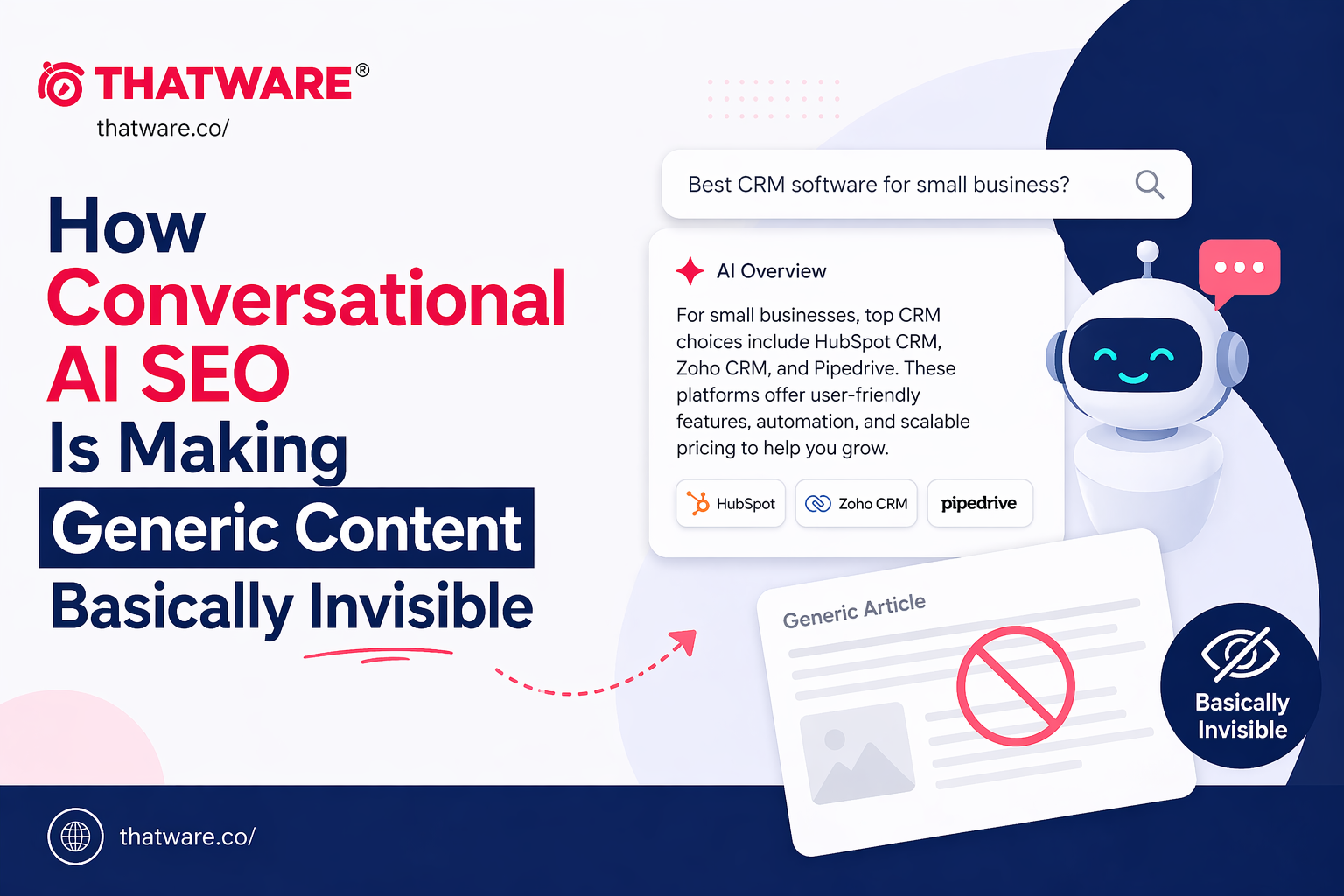
There’s a quiet culling happening in search right now, and most brands haven’t noticed it yet. Generic content – the kind that checks keyword boxes, hits a word count, and calls it a day – is being quietly deprioritized. Not penalized exactly. Just… passed over. And the engine behind that shift is conversational AI.
This isn’t about Google’s latest update or some new technical requirement. It’s more fundamental than that. The way people search has changed. The way the results surface has changed. And content that was perfectly adequate two years ago is now essentially invisible to a growing share of the audience that matters most.
Let me explain what’s actually going on.
The Shift to Conversational Queries (And Why It Changes Everything)
When someone types “best running shoes” into a search bar, they get a list. But when someone asks “what running shoes are best for someone with flat feet who runs about 20 miles a week on pavement?” – that’s a conversational query. And more and more people are searching that way. Voice search, AI assistants, ChatGPT, Google’s AI Overviews – they’ve all normalized the idea of asking full questions and expecting full answers.
Related reportWhen Your Home Starts Thinking for Itself: The Quiet Rise of Edge AI
Generic content doesn’t handle these queries well. A post that says “here are the top 10 running shoes” and lists them with affiliate links? It doesn’t even attempt to answer the nuanced question being asked. And AI-driven search systems, which are increasingly doing the work of surfacing answers, know the difference.
The content that gets cited, featured, and recommended is content that was built to have a real conversation with the reader – anticipating follow-up questions, addressing edge cases, connecting ideas in ways that actually help someone make a decision or understand something deeply.
That’s what conversational ai seo services are fundamentally designed to address. It’s not just about natural language keywords or long-tail phrases, though those matter. It’s about restructuring how content thinks – how it engages with intent, not just topicality.
Generic Content Has a Specific Problem
Here’s something I’ve noticed: a lot of brands genuinely don’t know their content is generic. They’ve been producing it consistently, optimizing it to what their analytics tools reward, and watching their rankings hold steady-ish. The problem isn’t always apparent until suddenly things shift and no one can quite explain why the traffic graph went sideways.
Related reportYour Identity, But Smarter: Why Digital Wallets Might Soon Hold More Than Money
Generic content tends to share some recognizable traits. It answers the most obvious version of a question. It avoids nuance because nuance is harder to produce at scale. It uses headers like “What Is [Topic]?” and “Why Does [Topic] Matter?” – not because those are necessarily bad questions, but because they signal a template was followed, not a reader was genuinely considered.
Conversational AI systems are trained on enormous amounts of text, which means they’ve gotten pretty good at recognizing that kind of surface-level engagement. They’re increasingly rewarding depth, specificity, and what you might call *intellectual honesty* – content that acknowledges complexity instead of flattening it.
What “Conversational” Actually Means in SEO Terms
There’s a tendency in marketing circles to treat “conversational content” as a stylistic thing – use shorter sentences, sound friendly, maybe add a question or two. That’s not really it.
Related reportBeyond Replies: Understanding the Shift from Chatbots to AI Agents
Real conversational content optimization is structural. It means thinking about query sequences – not just “what does someone want to know?” but “what do they want to know *next*?” It means writing content that serves a journey, not just a moment.
It also means being more explicit about entity relationships. Conversational AI systems don’t just match keywords; they understand context. Is your content clearly associated with a specific geography, industry, use case, or audience segment? The more clearly your content establishes those relationships, the more likely it is to surface in relevant conversational contexts.
A good conversational seo services strategy builds these layers deliberately. It’s not something you bolt on after the fact. It has to be part of how content is scoped, written, and structured from the beginning.
Why This Is Especially Brutal for Content Mills
If your content strategy involves producing a lot of volume quickly – outsourced writers, AI generation, templated briefs – you’ve probably already felt some pressure on performance. This trend is going to make that pressure worse.
The economics of generic content production were always based on a certain assumption: that enough decent content, optimized correctly, would aggregate into meaningful organic traffic. That assumption is weakening. Not because content volume doesn’t matter – it does – but because the threshold for “decent” has risen considerably.
Conversational AI systems, whether they’re powering AI Overviews or third-party answer engines, are pulling from a much smaller pool of genuinely useful content than the open web contains. Your content has to be in that pool to have visibility in those contexts. And generic content, almost by definition, doesn’t make the cut.
The Brands Quietly Getting This Right
There are brands doing this well right now. They’re usually not talking about it loudly because, candidly, it’s a competitive advantage they’d rather not broadcast. But the pattern is recognizable when you see it.
They publish less frequently than their competitors. What they publish tends to be longer, more specific, and built around real questions their audience actually asks – sourced from customer support transcripts, sales call recordings, forum threads, direct interviews. They update content regularly, not just republish it with new dates. They spend real time on semantic structure, making sure each piece of content fits clearly into a larger topical framework.
None of that is flashy. It doesn’t lend itself to a good LinkedIn post about “content hacks.” But it works – and as AI search becomes more central to how people find information, it’s going to keep working while generic content keeps fading.
What You Can Do Starting Now
If you’re worried your content falls into the generic category, here’s a useful test: read your best-performing pieces and ask honestly whether they answer the *specific* version of the question your audience is actually asking, or just the generic version.
Then look at your content briefs. Are they built around keyword clusters, or around genuine user intent journeys? That distinction matters more than it used to.
The shift to conversational search isn’t something brands can opt out of or wait out. It’s the direction things are moving, and the gap between brands that adapt and brands that don’t is going to grow wider fairly quickly. The good news is the path forward isn’t mysterious – it’s just harder than producing generic content at scale, which is precisely why most competitors haven’t taken it seriously yet.
That’s actually the opportunity.